Description
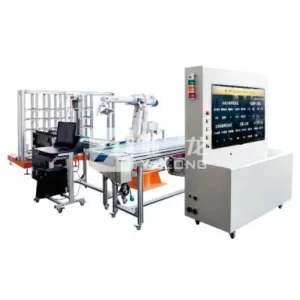
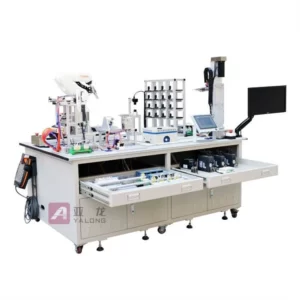
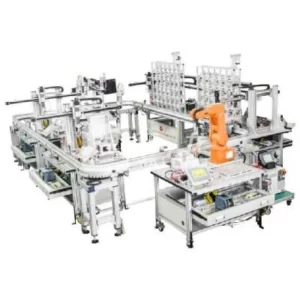
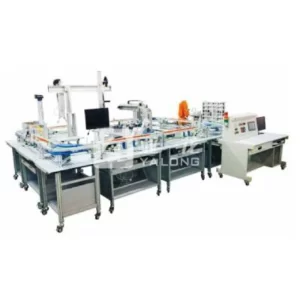
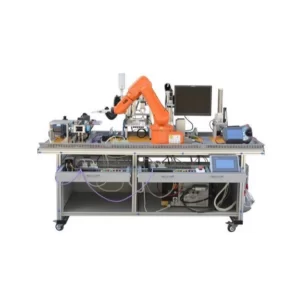
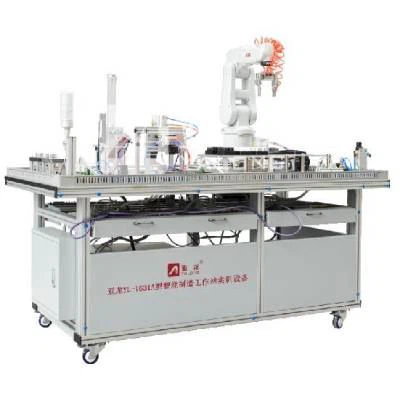
YL-1631A Smart Factory System Trainer is mainly composed of 5 units: feeding unit, processing unit, track unit, handling unit and palletizing unit installed on the aluminum alloy rail-type training platform. The electrical layout adopts a double-drawer type, and all its electrical controllers are installed on a mesh plate-type drawer. This electromechanical separation format is in line with the actual situation of the industry. In terms of control, the device configuration adopts a PLC network control scheme based on RS485 serial communication. The distributed control mode of interconnection between each PLC is realized through RS485 serial communication. The appearance is shown in the figure above. The equipment covers the application and maintenance of industrial robots, mechanical and electrical control technology, pneumatic control technology, process control technology, programmable control technology, automatic detection technology, motion control technology, network communication involved in the professional learning of mechatronics or electrical automation. Technology, man-machine interface and many other technologies. It has the characteristics of vocational, practical, open, industrial, teaching, versatility, etc. It is a set of practical training equipment that can be used for vocational skills training, training, assessment and skills competitions.
training projects
1.Organically integrates mechanical technology (including pneumatic technology), sensor detection technology, industrial robot application and maintenance, touch screen technology, PLC control and communication network technology, reflecting the characteristics of the modern manufacturing process.
★Practical training on the installation and commissioning of the feeding unit;
★Practical training on the installation and commissioning of the processing unit;
★Practical training of installation and debugging of palletizing unit;
★Practical training of installation and debugging of industrial robot handling unit;
★Practical training of installation and debugging of automatic production line control system;
2.The overall structure adopts an open and disassembly type, which can easily replace the modules. The content of the modules is determined according to the principle of productive functions and integrated learning functions, so that the required modules can be easily selected during teaching or competition. The equipment has strong scalability and upgradeability, such as:
★Replace or expand the work unit (such as processing unit, heat treatment unit, depth inspection unit, etc.);
★Electrical upgrade to fieldbus;
3.For teaching, teaching activities can be planned according to the work process-oriented, work-study combination mode, and the following tasks can be completed:
In line with the gradual teaching law
1) Installation and debugging project of pneumatic system:
Pneumatic actuators such as single rod cylinders, single rod cylinders, rotary cylinders, and pneumatic control components such as single-control electromagnetic reversing valves, dual-control electromagnetic reversing valves and magnetic switches configured with this equipment can complete the following pneumatic technology work tasks:
★Installation of pneumatic direction control loop;
★Installation of pneumatic speed control loop;
★Installation of swing control loop;
★Installation of pneumatic sequence control loop;
★Installation of pneumatic manipulator device;
★Pneumatic system installation and debugging;
★Design and installation of pneumatic integrated system;
2)Installation of electrical control circuits, PLC programming projects and industrial robot programming projects, etc.:
The PLC modules and sensors configured by the device can be used to complete the following tasks of PLC application technology:
★PLC control network control technology;
★The connection of the stepping motor control circuit and the writing of the control program;
★Connection and parameter setting of servo motor control circuit and control program writing;
★Pneumatic direction control program compilation;
★Pneumatic sequence action control program compilation;
★Pneumatic manipulator control program compilation;
★Belt conveyor control program compilation;
★Compilation of control program for mechatronics equipment;
★Automatic production line control program writing.
★Compilation of industrial robot control program
3)Installation, programming and debugging of PLC communication network:
★PLC control technology—485 communication technology programming and debugging
4) Mechanical and electrical equipment installation and commissioning project
4. This equipment is used for assessment or skill competition, and the occupational abilities that can be investigated:
★Assembly and adjustment capabilities of mechanical components;
★The ability to install and debug electromechanical equipment;
★Circuit installation ability;
★Pneumatic system installation and debugging capabilities;
★The use ability of stepping drive in automatic production line;
★Usability of servo drive in automatic production line;
★Field application and maintenance capabilities of industrial robots;
★The ability to use PLC control in automatic production lines;
★The ability to compile control programs of mechatronics equipment;
★The ability to install and debug the automatic control system.
★The ability to install, program and debug PLC network.
★Programming and debugging capabilities of man-machine interface and configuration technology
★In line with the national professional technical standard “Programmable Designer Level 3 Standard”