Description
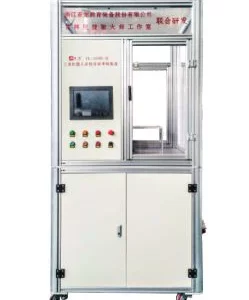
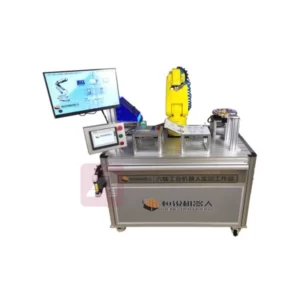
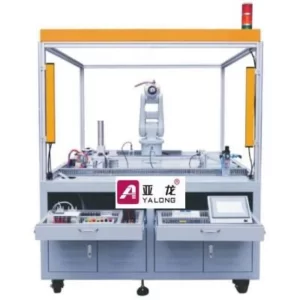
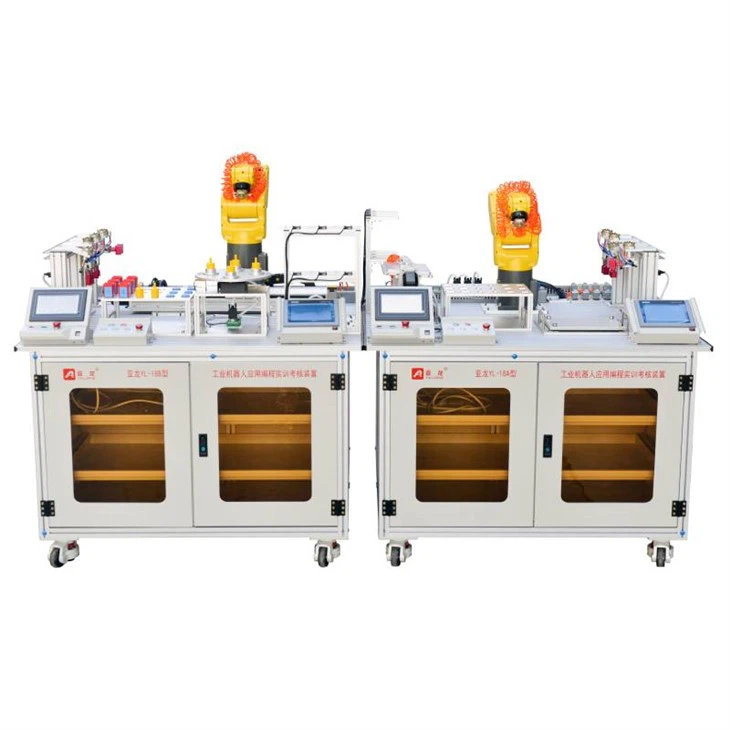
YL-18 Industrial Robotics Applications Programming Trainer is designed in a modular manner, and can be combined for three levels of project training, namely primary, intermediate, and advanced, which are progressive in sequence, and the high level covers low-level skill requirements.Users can conduct basic training assessments with a single desktop application, or double-desktop splicing to achieve dual-robot collaborative training assessments. The system integrates industrial robot technology, mechanical transmission technology, electronic and electrical technology, various operating technologies, intelligent sensing technology, programmable control technology, machine vision technology, computer technology, serial port communication technology, Ethernet communication technology and other advanced manufacturing technologies, covering professional knowledge of industrial robots, mechanical design, electrical automation, intelligent sensing, intelligent manufacturing and other disciplines. At the same time, the identification center is equipped with information-based teaching and assessment equipment such as surveillance cameras, electronic kanban, identity information verification equipment, multimedia teaching equipment, Yalong assessment system, etc., to create a modern and information-based examination room and a demonstration skill assessment assessment site.
Advanced industrial robot modular design:
The platform takes industrial robots as the core and is equipped with a variety of functional modules. Meet the teaching of different application scenarios of industrial robots. All modules are designed according to the standard electrical and mechanical interfaces, and the modules that meet the interface specifications can be used on the platform, which can be quickly replaced, replaced with each other, and combined freely.
Teaching and industrial application are closely integrated:
The platform integrates industrial robot control system, servo drive system, gas-hydraulic transmission system, machine vision system, combined with digital and analog process control technology, RFID technology, visual inspection technology, offline simulation, serial port communication technology, Ethernet communication technology, bus communication, etc. to fully demonstrate the application of industrial robots in intelligent manufacturing. Enable users to quickly master the application skills of industrial robots in actual industrial sites.
High security and high reliability:
For different learners of industrial robot application programming, it is necessary to consider the ability level of the learners, modular design for quick disassembly and assembly. During the learning process, the user’s misoperation has a high collision error tolerance rate, a small damage probability, and quick replacement and maintenance.
Openness and flexibility:
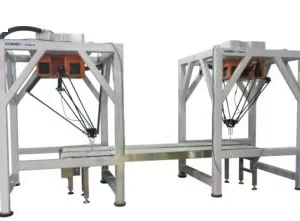
The application scenarios of industrial robots are composed of different functional modules. Learners can combine modules according to their own needs to create their own application scenarios and workflows of industrial robots. Double desktop splicing can also be performed to learn more complex industrial robot application skills. Users can also design new teaching modules, enrich training projects, and update teaching content according to the application scenarios of industrial robots at the enterprise site.
Support for virtual simulation:
In view of the large investment in training equipment in vocational colleges and the lack of sets, it is equipped with virtual simulation software. The motion of industrial robots can be directly controlled on the simulation software. At the same time, the industrial robot can feed back its own pose in real time, and reproduce the pose of the industrial robot in real time in the form of a 3D model in the simulation software. At the same time, the virtual simulation software integrates the offline simulation function, and users can use the offline simulation program to control the movement of industrial robots.
Integrate into the assessment system:
The platform uses the user to swipe the fingerprint to identify the identity of the person, and then powers on and off. After the verification is passed, the server outputs the personnel information and displays it on the man-machine touch screen, and generates a two-dimensional code for assessment and evaluation.
The assessment system can manage and display information such as online registration, project content, scoring standards, teacher management, and student management. After the user registers, the allocation of sessions can be realized, and the scoring scores can be automatically uploaded to the server for statistics and storage after the grade assessment is completed.
★Classic case: