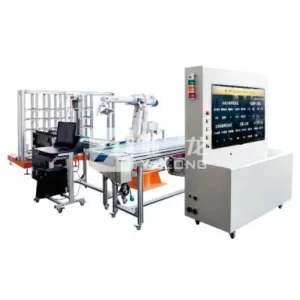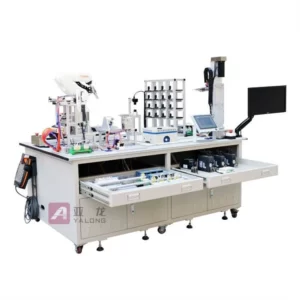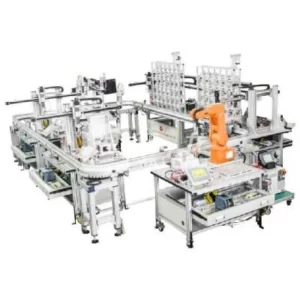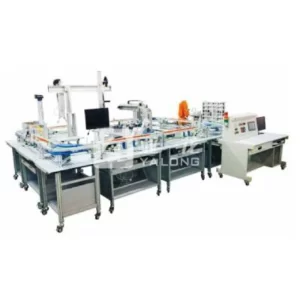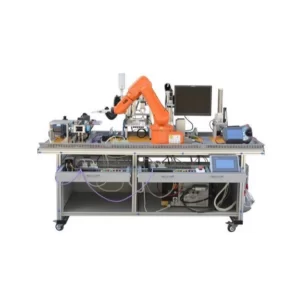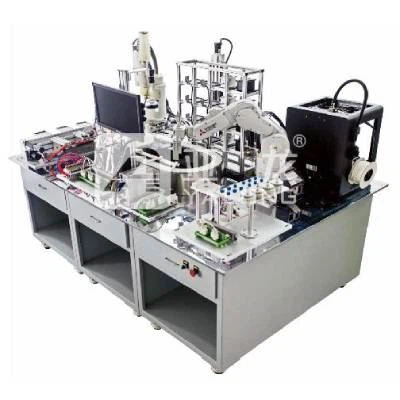
Description
Training program
1. Design and application of PLC
a) Data transmission function;
b) Timing, counting, shift function;
c) Comparative functional training;
d) Application of stepping function;
e) Application of jump function;
f) Application training of subroutine calling function;
g) Application training of interrupt control function;
h) Programming of the detection system;
i) Programming of the automatic storage system;
j) Complex trajectory control;
k) Program design of PLC control six-joint robot;
l) Program design of PLC control vision sensor;
2. Sensor technology and its application
a) Research and application of photoelectric sensor characteristics;
b) Research and application of characteristics of inductive sensors;
c) Research and application of fiber sensor characteristics;
d) Research and application of position sensor characteristics;
e) Research and application of characteristics of RFID systems;
f) Research and application of characteristics of vision sensors;
3. Pneumatic control technology
a) Working principle and application of electronically controlled pneumatic valve;
b) Working principle and application of air ejector;
c) Working principle and application of standard cylinder;
d) Working principle and application of various pneumatic grippers;
e) Working principle and application of air compressor;
4. Configuration monitoring and HMI Technology
a) Basic application of configuration monitoring software;
b) Configuration monitoring software communication application;
5. Mechanical structure training
a) Research on the design and characteristics of the timing belt transmission mechanism;
b) Research on the design and characteristics of linear guides;
c) Research and application of ball screw characteristics;
6. Fault detect technology training
a) Exclusion training for program fault setting;
b) Exclusion training for parameter fault setting;
c) Exclusion training for electrical wiring fault settings;
d) Exclusion training for mechanical fault setting;
7. Network communication technology
a) Principles and applications of network communication;
b) 232 communication principle and application;
c) 485 communication principle and application;
d) Research and application of CC-LINK module;
e) Research and application of CC-LINK communication protocol;
f) Research on communication between CC-LINK master station and slave station;
8. Manipu;ator transfer system control
a) Single-axis arm reciprocating motion control training;
b) Biaxial arm linear motion control training;
c) Biaxial arm curve motion control training;
d) Three-axis robotic space linear control training;
e) Three-axis robot space curve control training;
f) 5-axis robotic space linear control training;
g) Five-axis manipulator space curve control training;
h) Six-axis robot characteristics research, application control training;
i) Robotic transfer control technology training;