Description
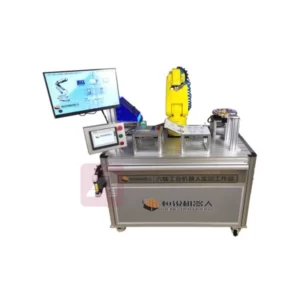
The YL-1801A Multi-robot Factory Training System (Pen Production)consists of 4 industrial robot workstations. Siemens S7-1500 PLC is used to realize the cooperative control of 4 substations through Ethernet communication. The substation includes YL-1801A-1 loading and unloading workstation, YL-1801A-2 welding workstation, YL-1801A-3 engraving station handling workstation, and YL-1801A-4 palletizing workstation. Each workstation can also run independently.
Each set can satisfy multiple students for operation and learning at the same time. The function of the training room focuses on the students’ practical programming training, and is used in conjunction with the simulation training room. This room allows students to master professional knowledge and skills through real training and teaching, and upgrade the past confirmatory training to students The self-initiated and hands-on learning is not limited to a solution to the problems of industrial robot debugging encountered by students in the learning process, highlighting the expansion of students’ problem-solving abilities, and especially emphasizing students’ “learning” and practical problem-solving and hands-on abilities Training, the training room is to refine the core skills required by the corporate job for repeated training.
Overall layout of equipment

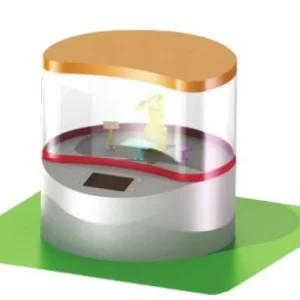
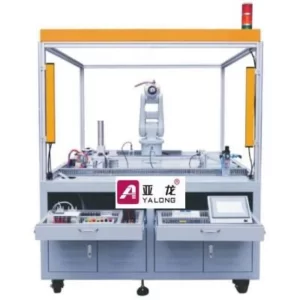
YL-1801A Appearance Picture 1 (The picture is for reference only, and the actual product is the main product)

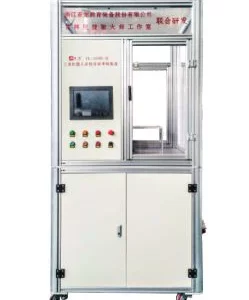
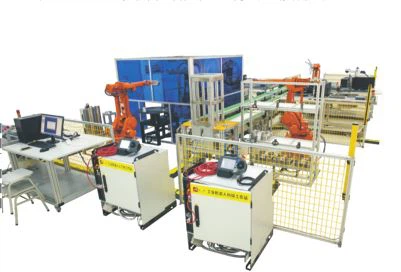
YL-1801A Appearance Figure 2 (The pictures are for reference only, and are based on the actual product)

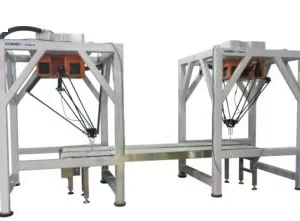
YL-1801A plane layout (pictures are for reference only, the actual product is the main product)
Note: The overall size of the equipment is 10300*6000, and it is recommended that the size of the training room is not less than 13000*7000
Process flow
The whole process flow is divided into real welding and virtual welding. The actual welding process of the four substations is as follows:
(1) Manually load the lifting table, fill the cylinder in the lifting device position, install a stack of bottom plates in the non-lifting device position, and transport the cylinder and the bottom plate to the loading and unloading station on the turntable by the handling robot. The workpiece of the turntable rotates to the welding station, and then the workpiece is clamped by a pneumatic clamp.
(2) The welding robot welds the workpiece.
(3) After the welding is completed, the clamp is loosened, and the turntable turns the welded workpiece back to the loading and unloading station, and the loading and unloading robot blows air and cool air on the welded workpiece to complete the cooling.
(4) The loading and unloading robot transports the welded workpiece to the A point of the conveyor belt 1. After the transportation is completed, the lifting device automatically lifts the cylinder to the pre-installed position.
(5) The conveyor belt transports the workpiece to point B, waiting for the engraving station handling robot to transport it to the engraving machine for engraving processing.
(6) After the engraving is completed, the engraving station handling robot will take the workpiece out of the engraving machine and place it at point C of the conveyor belt 2.
(7) The conveyor belt transfers the workpiece to the D point position, and the workpiece box conveyor belt will send a workpiece box to the E point position as long as it detects that there is no workpiece box at the E point.
(8) The palletizing robot first puts four workpieces into the workpiece box, and then palletizes the workpiece box into the three-dimensional warehouse.
The full-line operation process during virtual welding of the four substations is as follows:
(1) Manually load the lifting table, fill the cylinder in the lifting device position, install a stack of bottom plates in the non-lifting device position, and transport the cylinder and the bottom plate to the loading and unloading station on the turntable by the handling robot. The workpiece of the turntable rotates to the welding station, and then the workpiece is clamped by a pneumatic clamp.
(2) The welding robot performs virtual welding on the workpiece.
(3) After the virtual welding is completed, the clamp is loosened, and the turntable turns the welded workpiece back to the loading and unloading station.
(4) The loading and unloading robot moves the bottom plate back to the non-elevating device, and transports the cylinder to point A on the conveyor belt 1. After the transportation is completed, the lifting device automatically lifts the cylinder to the pre-installed position.
(5) The conveyor belt transports the workpiece to point B, waiting for the engraving station handling robot to transport it to the engraving machine for engraving processing.
(6) After the engraving is completed, the engraving station handling robot will take the workpiece out of the engraving machine and place it at point C of the conveyor belt 2.
(7) The conveyor belt transfers the workpiece to the D point position, and the workpiece box conveyor belt will send a workpiece box to the E point position as long as it detects that there is no workpiece box at the E point.
(8) The palletizing robot first puts four workpieces into the workpiece box, and then palletizes the workpiece box into the three-dimensional warehouse.