Description
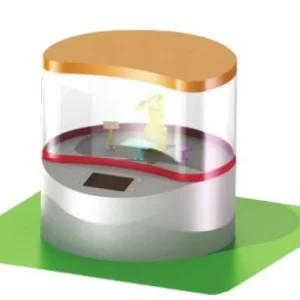
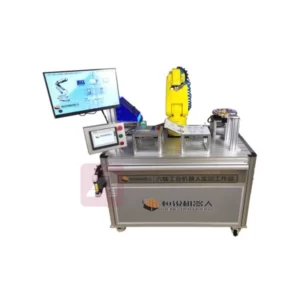
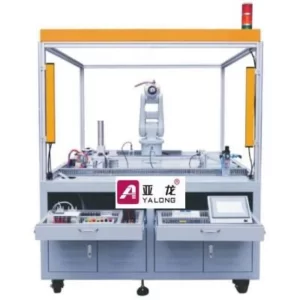
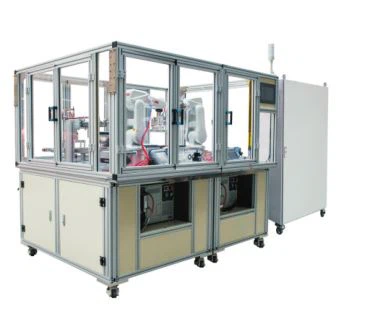
The industrial robot collaborative workstation is a set of teaching and training devices for robot handling and assembly and finished product inspection. This collaborative workstation mainly completes the assembly of the gearbox and detects the assembled gearbox. The process is that the transmission unit transports the parts into the detection area of the vision inspection unit, the vision sensor judges the posture of the part, the robot corrects the posture of the part according to the data given by the vision sensor, and then the two robots move together to move the part Assemble on the assembly platform. After the gearbox is installed, move to the testing platform to test and adjust the speed of the assembled gearbox.
This collaborative workstation is mainly composed of conveying unit, visual inspection unit, robot collaborative assembly unit and finished product inspection unit.
Features
2.1 Multifunctional robot gripper
This workstation has two robot grippers with different functional specifications, and the grip is mainly composed of air cylinders. Each gripper can realize different functions and can grab different specifications and different types of parts.
2.2 Linear conveying
Adopting industrial linear conveying mechanism, belt conveying is widely used in the transportation of industrial solid objects. It has the characteristics of continuous and uniform conveying, high production efficiency, stable operation, low power consumption, low operating cost, and convenient maintenance and repair. .
2.3 Two robots work together
The two machine industrial robots are not only a whole, but also two independent systems. A whole is mainly reflected in the close cooperation of two robots, coordinated operation, and precise assembly of the gearbox; two independent systems show that both robots can independently perform training operations and programming learning.
2.4 can detect the processed gearbox
The main body of the gearbox is made of transparent material, which not only allows students to observe and understand the structure of the gearbox intuitively, but also conduct online debugging and measurement of the finished gearbox.
product structure
- Conveying unit


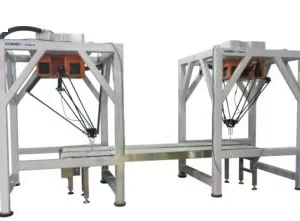
This unit mainly has two conveying mechanisms, and the material tray can be transported on the two conveying lines through the air claw equipped on the conveying line.
- Visual inspection unit

The main part of this unit is the vision system.
The vision system is a system that enables the robot to have visual perception functions, and is one of the important parts of the robot system. The vision system can obtain a two-dimensional image of the environment through a vision sensor, analyze and interpret it through a vision processor, and then convert it into a symbol, allowing the robot to recognize the object and determine its location.
In this workstation, when the conveying unit sends the parts to the detection range of the vision sensor, the vision sensor transmits the part type, placement and position coordinates to the robot, ensuring the accuracy and purpose of the robot’s grasping of the parts Sex.
- Robot cooperative assembly unit

This unit is mainly composed of two industrial robots and two sets of precision robot fixtures.
Each robot fixture is equipped with a variety of pneumatic components, which can satisfy the grasping of different parts, and can realize the assembly of multiple parts of different specifications through these fixtures.
The two robots talk to each other and can realize signal sharing. To ensure the coordination and stability of the actions of the two robots, it is excluded that the two robots appear in the same space at the same time during the joint assembly process, and the collision of the robots is avoided. In the assembly process, the two robots cooperate with each other. For example, one robot can accurately and stably transfer parts to another robot fixture after clamping, which greatly improves the plasticity of robot assembly.
- Finished product inspection unit

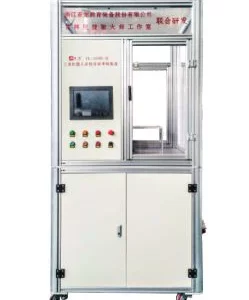
This unit is mainly to test the gear box assembled by the robot. The gear box is made of integrated transparent material, which not only improves the aesthetics, but also facilitates students to learn the working principle of the gear box.
The finished product inspection unit is equipped with a set of motion system, which allows students to test and debug the assembled gearbox in combination with the motion system.
- Electrical control system

The industrial robot collaborative workstation adopts an electromechanical separation structure and is equipped with an independent electrical control cabinet.